
Ask anyone selling marketing to jewelers what is wrong with your ads and the answer comes back before you have finished the question: you need more creative. More videos. More variations. Feed the algorithm. Thirty ads a month or you are falling behind.
It is the most expensive advice in jewelry advertising, and it is wrong in a way that is very good for the people giving it. You do not need more creative. You need fewer, tested properly. Thirty ads with no structure is not a strategy. It is thirty ways to fail somewhere you cannot see, invoiced monthly.
What stops a thumb on a jewelry ad is almost never the perfect product shot on white. It is motion, a hand, and the work: light moving through a stone, a piece on a real person at real scale, a setter’s hands at the bench. To find out which of your ideas works, run a few creatives with a couple of headlines and texts as one ad, against what already works, testing one idea per round, and judge them on a group of signals read together rather than on whichever one looked cheapest in week one. Kill the ad that eats the most money for the least return, not the one that started slow. And the product itself stays out of reach of any machine that wants to improve it, because the photograph is a promise about a thing someone will hold.
IWhy the beautiful product shot gets scrolled straight past.
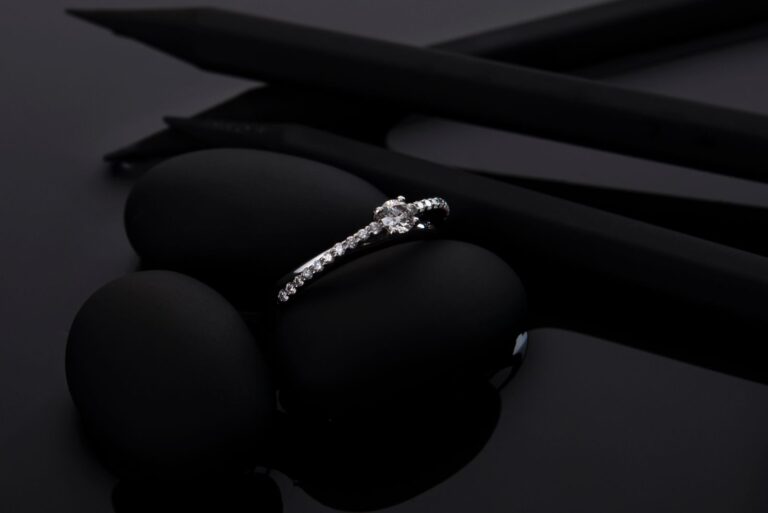
Here is the uncomfortable truth about the photograph you paid most for. A ring on a white background, perfectly lit, every facet sharp, is a gorgeous image and an invisible advertisement.
It is invisible because it looks like everything. Every jewelry ad in the feed is a ring on a white background, perfectly lit, every facet sharp. Call it the white-background mausoleum: a row of immaculate tombs, each one honouring a piece nobody stopped to look at. A thumb moving through Instagram at speed does not stop for the thing it has seen four hundred times this week. It stops for the thing that does not look like an ad.
Those catalogue shots have a job, and it is a real one: the product page, the retargeting card, the moment someone already interested wants to see the detail. They are not what stops a stranger. Using them to stop a stranger is like hiring a beautiful mannequin to work the door.
IIThe three things that actually stop a jewelry thumb.
Motion. Light moving through a stone does something a still image cannot, and the eye is built to notice movement before it notices anything else. A slow turn of a ring under a single light. Sparkle that changes as the piece moves. Two seconds of that out-performs a flawless still more often than any photographer wants to admit.
A hand and a body, at real scale. Nobody buys a ring for a white void. They buy it for a hand, usually a specific one. A piece on a real finger, a necklace on a real collarbone, a bracelet moving on a real wrist answers the question every jewelry buyer actually has, which is “what will it look like on me,” before they have consciously asked it.
The work. This is the one jewelers undervalue most, because to them it is just Tuesday. The bench. The setter’s hands. A stone being chosen under a loupe. A custom piece going from sketch to wax to metal. To you that is a day at work. To somebody scrolling past, it is the most interesting thing in their feed, because almost nobody gets to see how a beautiful object is made. It also does a second job no product shot can: it proves you are real, skilled and human, which in a four-figure purchase from a store they have never visited is most of the battle.
And a fourth, used sparingly: a bit of personality. Light humour, a behind-the-scenes moment that went sideways, the honest face of the person who runs the place. Not a gag reel. Just evidence that a person is here.
What does not work, and it is worth saying bluntly: the sale announcement. “Twenty percent off this weekend only,” again, the same weekend it was off last month. Call it the buy-from-us scroll. It reads as desperate, it trains your best customers to wait for the next discount, and it attracts exactly the people who will leave you the moment a competitor goes to twenty-five.
III“More creative” is a trap. Here is the alternative.
The reason “more creative” sounds right is that some of your ads will fail, so more shots on goal seems sensible. The problem is that thirty unstructured ads do not give you thirty data points. They give you noise.
Every ad competes for the same budget, so each one gets a thin slice, so none of them gather enough signal to judge, so you end up picking winners by luck. Meta learns by putting more of the spend behind what works, and thirty separate ads each learn alone, from a slice too thin to teach anything. Nothing ever settles. You have built an expensive random number generator and given it your logo.
What works instead, in plain terms:
- Run a few creatives as one ad, not as separate ads. Three creatives with two headlines and two primary texts, set up as a single flexible ad, so Meta treats it as one thing and its learning piles up in one place instead of being scattered across thirty.
- Test it against what already works. Keep your proven ads running as the baseline in the same campaign, same budget, same conditions, and add the new idea alongside them. That is how you isolate what the new idea is actually worth.
- One idea per round. One new concept per test. If you change the concept, the audience and the offer in the same week, and the result moves, you have learned nothing about any of them. You have just watched a number change, which is a hobby, not a method.
Fewer ads, tested properly. It feels slower. It is. So is checking a stone before you set it, and nobody at your bench calls that a waste of time.
IVHow to read a creative without fooling yourself.
This is where most accounts go wrong, and it is not a creative problem, it is a reading problem.
The single worst habit in jewelry advertising is judging an ad by cost per result in its first few days and killing whatever looks expensive. Early numbers lie. An ad that looks cheap in week one is often just catching the easiest people first, and an ad that looks expensive is often doing slower, more valuable work further up the funnel. Kill on day three and you are frequently killing the ad that would have made the sale possible later.
So read four signals together, never one alone. We call it 4Pi: Spend, CPM, Frequency and Cost-per-Result. Where Meta chooses to put money tells you what it trusts. CPM tells you what attention costs. Frequency tells you whether you are reaching new people or nagging the same ones. Cost per result tells you the outcome. Together they tell you what role an ad is actually playing, which is a very different question from whether it looks cheap.
And when something has to go, remove the biggest offender: the ad eating the most spend for the least return, relative to what it is being given. Not the slow starter. Then let the account settle for a few days before you touch anything else, because every change shakes the whole thing and you need it still to see what happened.
Stability is the goal, not excitement. A boring account that holds steady is making money. An exciting account that lurches every week is making a story.
VThe rule about the product that is not negotiable.
One rule, and it applies whether the creative is shot by a photographer, filmed on a phone, or assembled with modern tools.
Nobody digitally improves the piece. It can be photographed faithfully. It can be composited, meaning a real photograph of the real piece placed into a scene. What it cannot be is regenerated, enhanced, smoothed, brightened or reimagined by a model, because a jewelry photograph is a promise about an object somebody will eventually hold in their hand. An AI that makes a diamond look a little better than it is has not improved your ad. It has written a cheque your inventory cannot cash.
That rule extends to the platform. Meta now offers automated creative enhancements that alter ads at the moment of delivery, and on a fine-jewelry account those should be off, for the same reason: the platform would be improving a promise you then have to keep.
A customer who receives exactly what your ad showed comes back. A customer who receives a slightly worse version of what your ad showed writes a review, and you do not get to pick which words they use.
VIWhat to make this month, concretely.
If you do nothing else, make these, in roughly this order of value:
- A slow, single-light turn of your best piece, ten seconds, phone on a stand. No music needed, no edit, just the light doing its work.
- The same piece on a real hand, at real scale, in daylight.
- Thirty seconds at the bench: a setting, a polish, a stone being checked. Nobody needs it narrated. The work explains itself.
- The founder or a jeweler talking to camera for twenty seconds about why one piece is made the way it is. One idea, said plainly.
- A real customer’s piece being collected, with their permission. The reaction is the ad.
Run three of those as one test against whatever is already working. Change nothing else. Read the four signals after a week. Keep what holds steady. Repeat with the next idea.
That is the whole system. It is not glamorous, and you will never see it on a forty-videos-a-month package price list, which is exactly why it works.
VIISelf-diagnostic: is your creative working, or just busy?
The creative diagnostic.
- How many active ads are you running right now, and does each one get enough budget to be judged on its own?
- Are most of your ads product shots on a plain background?
- Do any of your ads show a piece moving, on a real person, or being made?
- When did you last run a new idea against your proven ads in the same campaign, same budget?
- In your last test, how many things did you change at once?
- When you decide an ad has failed, which number are you looking at, and is it only cost per result?
- How many days old was the last ad you turned off for “not performing”?
- Is there a discount in your current creative? Has there been one for most of the year?
- Has any version of your product image been brightened, smoothed or regenerated by software?
- If a customer received exactly what your best ad shows, would it match the piece in the box?
If 2 is yes and 3 is no, you do not have a creative volume problem. You have a creative content problem, and more of the same will not fix it.
Straight answers
What kind of ads work best for jewelry stores?
Ads with motion, a real person and the work itself. Light moving through a stone, a piece on a real hand at real scale, and footage of the bench, a setting or a custom piece being made consistently stop more scrolling than a perfect product photograph on a plain background, which looks like every other jewelry ad in the feed. Keep the catalogue shots for product pages and for people who are already interested; they are not what stops a stranger.
How many ads should a jewelry store run at once?
Fewer than most people expect. Split a normal budget across many separate ads and each one gets too little spend to be judged, so you end up picking winners by luck. A better structure is a small number of creatives run as a single flexible ad, alongside your proven ads in the same campaign, so the learning concentrates in one place and each test can actually produce an answer.
How do I test jewelry ad creative properly?
Keep your proven ads running as the baseline, and add one new idea alongside them in the same campaign, with the same budget and conditions. Change only one thing per test, so a change in results tells you what caused it. Give it time to settle before judging, read several signals together rather than cost per result alone, and when something has to go, remove the ad that consumes the most spend for the least return rather than the one that started slowly.
What is 4Pi in Facebook ads?
A way of reading an ad’s role by looking at four signals together: Spend, CPM, Frequency and Cost-per-Result. Spend shows what Meta trusts, CPM shows what attention costs, frequency shows whether you are reaching new people or repeating to the same ones, and cost per result shows the outcome. Read together they tell you whether an ad is doing early-funnel work or closing sales, which cost per result alone cannot.
Should jewelry ads show prices or discounts?
Sparingly, and almost never as a recurring discount. A weekly “twenty percent off” teaches your best customers to wait for the next sale and attracts buyers who leave the moment a competitor goes lower. For fine jewelry, the content that builds trust, the work, the materials, the person behind it, tends to outperform the price announcement, and it does not erode your margin while it does it.
Can I use AI to make jewelry ads?
For the scene, the copy and the layout, carefully. For the piece itself, no. The product should be photographed faithfully or composited, meaning a real photograph of the real piece placed into a setting, never regenerated or enhanced by a model. In fine jewelry how a stone catches light and the colour of the metal are the product, and a customer who receives something that looks worse than the ad feels misled, whatever tool made the image.
This is part of our fine-jewelry operating series. For what to check when ads are running and not selling, see why your jewelry store’s Meta ads are not producing sales. For why boosting a nice photograph is not the same as advertising it, see the boost button is not an advertising strategy.
Film the light. Put the piece on a hand. Show the bench. Test three ideas against what already works, change one thing, read four signals, and leave the product exactly as it is. If you want an operator who runs creative testing this way, see how we work or email info@endicodatastrategic.com directly. The founder reads every inquiry within one business day.
Want an operator running this instead of reading about it?
The founder is on every account, and we do not work with two jewelers in the same trade area. No binding contracts, and you own everything: the ad account, the pixel, the creative, the audiences.
Book a strategy call →